Books
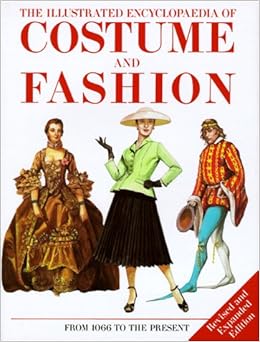 This
encyclopedia provides visual and written reference for fashion from 1066
to the 1990s. Because of the extensive time frame, it focuses on points in fashion of significant change. Each page is
dominated by the illustration. Most of them feature a
male and female figure in the dress of the
time, but some feature less or more persons of varying age and gender. A brief description of the
clothes is given. Sometimes historical context is given, however, this is not a good
source for gathering context about the fashion
of the time. Rather, it allows the reader to experience a visual progression in
trends. It should also be noted that the fashion is limited to the upper class
western experience.
This
encyclopedia provides visual and written reference for fashion from 1066
to the 1990s. Because of the extensive time frame, it focuses on points in fashion of significant change. Each page is
dominated by the illustration. Most of them feature a
male and female figure in the dress of the
time, but some feature less or more persons of varying age and gender. A brief description of the
clothes is given. Sometimes historical context is given, however, this is not a good
source for gathering context about the fashion
of the time. Rather, it allows the reader to experience a visual progression in
trends. It should also be noted that the fashion is limited to the upper class
western experience.
·
The
Illustrated Encyclopedia of Costume and Fashion
This
encyclopedia provides visual and written reference for fashion from 1066
to the 1990s. Because of the extensive time frame, it focuses on points in fashion of significant change. Each page is
dominated by the illustration. Most of them feature a
male and female figure in the dress of the
time, but some feature less or more persons of varying age and gender. A brief description of the
clothes is given. Sometimes historical context is given, however, this is not a good
source for gathering context about the fashion
of the time. Rather, it allows the reader to experience a visual progression in
trends. It should also be noted that the fashion is limited to the upper class
western experience.
Cassin-Scott, J.
(1994). The Illustrated Encyclopedia of Costume and Fashion. New York.:
Sterling Pub.
 This book starts by
going over basic figure drawing techniques and talking about the way clothes fit the body. It covers full figures
and selected areas of
concentration such as eyes, hands, and feet. This establishes a basis for creating realistic and expressive costume
renderings. It then moves on to materials
and techniques of costume illustration. The bulk of the book is devoted to creating period based silhouettes.
It starts with 3000 B.C. and goes
through all the major time periods with discussion and illustrations. It is broken down by sections of the
body: headdress/hair, neck/shoulder/arm,
waist/hip/skirt, and footwear. The book concludes with an overview of how to create a professional design portfolio.
It contains an index for quick reference.
This book starts by
going over basic figure drawing techniques and talking about the way clothes fit the body. It covers full figures
and selected areas of
concentration such as eyes, hands, and feet. This establishes a basis for creating realistic and expressive costume
renderings. It then moves on to materials
and techniques of costume illustration. The bulk of the book is devoted to creating period based silhouettes.
It starts with 3000 B.C. and goes
through all the major time periods with discussion and illustrations. It is broken down by sections of the
body: headdress/hair, neck/shoulder/arm,
waist/hip/skirt, and footwear. The book concludes with an overview of how to create a professional design portfolio.
It contains an index for quick reference.
·
A Handbook
of Costume Drawing
 This book starts by
going over basic figure drawing techniques and talking about the way clothes fit the body. It covers full figures
and selected areas of
concentration such as eyes, hands, and feet. This establishes a basis for creating realistic and expressive costume
renderings. It then moves on to materials
and techniques of costume illustration. The bulk of the book is devoted to creating period based silhouettes.
It starts with 3000 B.C. and goes
through all the major time periods with discussion and illustrations. It is broken down by sections of the
body: headdress/hair, neck/shoulder/arm,
waist/hip/skirt, and footwear. The book concludes with an overview of how to create a professional design portfolio.
It contains an index for quick reference.
This book starts by
going over basic figure drawing techniques and talking about the way clothes fit the body. It covers full figures
and selected areas of
concentration such as eyes, hands, and feet. This establishes a basis for creating realistic and expressive costume
renderings. It then moves on to materials
and techniques of costume illustration. The bulk of the book is devoted to creating period based silhouettes.
It starts with 3000 B.C. and goes
through all the major time periods with discussion and illustrations. It is broken down by sections of the
body: headdress/hair, neck/shoulder/arm,
waist/hip/skirt, and footwear. The book concludes with an overview of how to create a professional design portfolio.
It contains an index for quick reference.
Baker, G. O. (1992). A handbook of costume drawing: A guide
to drawing the period figure for costume design students. Boston: Focal Press.
- The Costume Technician’s Handbook by
Rosemary Ingham and Liz Covey
 First published in 1992 and now
on its third edition, this book has been a trusted source of information for
many years. It is mainly instructional in nature, serving to build practical
skills rather than talk about theory. This is a great ‘how to’ resource for the
beginning costumer. It covers everything from pattern development to shop
safety. It can be used to establish a foundation to build from, or as a quick
reference for the more seasoned sewers. Complete with pictures and diagrams,
the layout of this book is easy to follow. It covers an enormous amount of
information, but separates it out into digestible sections. It is important to
note however, that this resource is more about breadth than depth. It can serve
as a starting point for many things, but more specialized information will be
needed to complete most projects.
First published in 1992 and now
on its third edition, this book has been a trusted source of information for
many years. It is mainly instructional in nature, serving to build practical
skills rather than talk about theory. This is a great ‘how to’ resource for the
beginning costumer. It covers everything from pattern development to shop
safety. It can be used to establish a foundation to build from, or as a quick
reference for the more seasoned sewers. Complete with pictures and diagrams,
the layout of this book is easy to follow. It covers an enormous amount of
information, but separates it out into digestible sections. It is important to
note however, that this resource is more about breadth than depth. It can serve
as a starting point for many things, but more specialized information will be
needed to complete most projects.
Ingham, R., &
Covey, L. (2003). The Costume Technician's Handbook (Third ed.).
Portsmouth, NH: Heineman.
·
Draping
for Fashion Design by Hilde Jaffe and Nurie Relis
 Draping is one of the
quintessential skills for professional costumers. This book helps the costumer
bring their designs to life. It covers all the basics and some advanced
techniques for draping. The book starts by listing all the supplies needed for transitioning
from flat patterning to three dimensional design. It covers techniques for
draping waistlines, skirts, slacks, collars, sleeves, shifts, princess lines,
dart manipulation, and facings. Once the reader has mastered these areas, there
are infinite combinations that can be used to accomplish drapings specific to
their designs. One of the shortcomings is that, while giving instructions for
marking, the book does not provide sufficient information on how to transfer
the design into a paper pattern. However the illustrations and numbered
instructions make the rest of the process very user friendly.
Draping is one of the
quintessential skills for professional costumers. This book helps the costumer
bring their designs to life. It covers all the basics and some advanced
techniques for draping. The book starts by listing all the supplies needed for transitioning
from flat patterning to three dimensional design. It covers techniques for
draping waistlines, skirts, slacks, collars, sleeves, shifts, princess lines,
dart manipulation, and facings. Once the reader has mastered these areas, there
are infinite combinations that can be used to accomplish drapings specific to
their designs. One of the shortcomings is that, while giving instructions for
marking, the book does not provide sufficient information on how to transfer
the design into a paper pattern. However the illustrations and numbered
instructions make the rest of the process very user friendly.
Jaffe, H., & Relis, N. (1973). Draping for fashion
design. Reston, VA: Reston Pub.
·
Sewing Basics
This article is a fantastic
starting place for getting a handle on sewing terminology. It contains a
glossary of terms that will help the new costumer sort through the jargon of
the shop without the embarrassment of admitting they don’t recognize a word.
Fundamental definitions such as bias and seam allowance are essential to
preventing potentially costly mistakes. The article also contains a basic list
of tools used in sewing. Additionally, it provides numbered diagrams of some of
the simpler hand stitches. It shows how to create bias tape and binding as well
as miter corners with illustrations to guide the reader through the process with
ease. The information here is great for developing the groundwork to build off
of throughout one’s studies.
Sewing Basics. (2016). Quilting Arts Magazine, 76-79
·
Costume Fabrics
This article serves as an
introduction to sewing with different types of materials. It takes ten basic
categories of fabrics and gives some of the fundamental advice for working with
them. It is targeted at beginning sewers, so it is very easy to follow. It goes
over spandex, sequined fabrics, lace, felt, fringe, fleece, chiffon, faux fur,
leather and tulle. It gives advice on everything from what size needle to use,
following grainlines, ironing, and finishing edges. The intent is really to
give advice for the everyday sewer. But the mom making her child’s Halloween
costume often faces a lot of the same fundamental challenges of the seamstress
creating a costume for the Broadway stage. The article does not cover
everything, but it lays the groundwork for someone getting their start in the
field.
LaFoille, N. (2013). 10 Costume Fabrics. Sew News, (337),
28-31.
·
“Bringing Portraits Alive: Catherine Paula Han
Interviews Andrea Galer, the Costume Designer for Jane Eyre”
This
journal article offers a case specific look at the costumer’s experience. The
interview covers the process used by Andrea Galer in designing for Jane Eyre. A
lot of discussion is given to the challenges that come with doing a historical
piece. There is also the discussion of budgetary limits, having to make
duplicate costumes for films, ethical sourcing, and other challenges the
costumer must face. Additionally, attention is given to the effects of
character, actor, and audience on the design of a costume. Color choices,
material choices, and other design elements are analyzed. This can be a useful
resource for a costumer in the developmental stage of their costumes because it
gives insight into the various factors one has to consider when creating
clothing for stage or film.
Bringing
Portraits Alive: Catherine Paula Han Interviews Andrea Galer, the Costume
Designer for Jane Eyre (BBC, 2006). (2014). Bronte Studies, 39(3), 213-224.
doi:10.1179/1474893214Z.000000000116

No comments:
Post a Comment